
Hayes County Court Records After Arrest
The post-arrest path in Hayes County usually starts with law enforcement taking a person into custody, followed by sheriff intake and jail booking. At that point, the jail side of the record may reflect the arresting agency's stated charge or hold reason. The court side starts to matter when the case is processed for an initial appearance and when the prosecutor decides what formal charges, if any, should be filed. The official Hayes County Attorney page identifies D. Eugene Garner as the county attorney, and that office is the local prosecutor for criminal matters involving the county or state.
Booking data and court records serve different jobs. Custody status, booking date, and release questions belong first with jail inmate records, while booking photos and photo request issues belong with jail mugshots. Court records after a jail arrest focus on the charge document, case number, party list, register of actions, bond orders, court costs, hearings, and disposition. A booking charge can be a clue, but the filed court charge is the better record for what the prosecutor actually put before a judge.
Hayes County Court Case Search
Nebraska's online court search is JUSTICE one-time case search. It covers criminal, civil, traffic, juvenile, and probate cases filed in all county and district courts in Nebraska, including Hayes County. The system uses party-name searching and has a lag after new court entries are made, so a very recent arrest may not appear right away. When the case has been entered, the search can show public case detail, party listing, court costs, payments, register-of-actions entries, and certain document images that were filed or uploaded after the system's document-image date threshold.
The state court search is paid. The JUSTICE terms state that a one-time search costs $17, and the fee applies even when no result is found. Results remain available for three calendar days. The site also warns that broad party-name searches may return too many records, while too many filters can miss a case. For Hayes County court records after arrest, start with the defendant's full legal name, then narrow only if the name search returns too many matches.
The Nebraska JUSTICE search landing page is the official statewide entry point for court records after a Hayes County jail arrest.
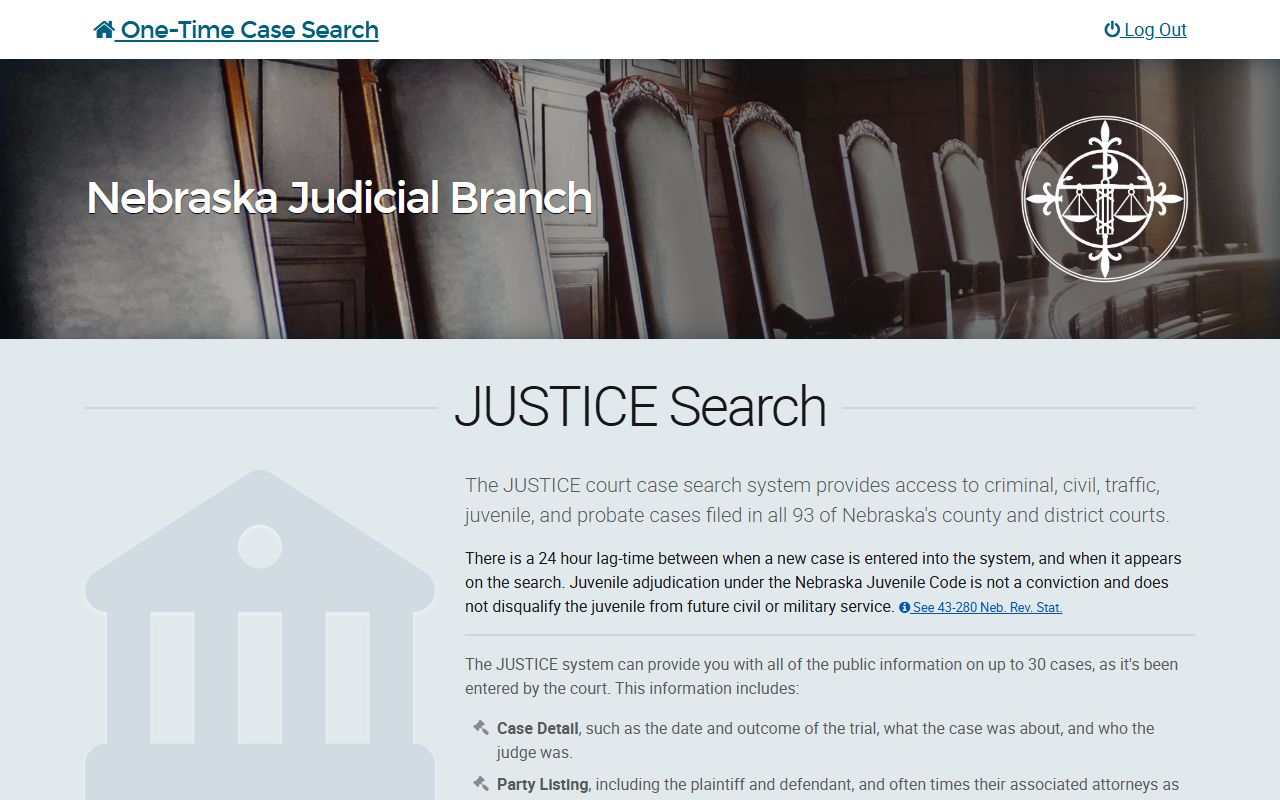
The screenshot reinforces that the court search is separate from jail custody confirmation and should be used after a case is entered.
| Field or Step | Type | Required | Notes |
|---|---|---|---|
| Terms agreement | Checkbox | Yes | The user must accept the terms before starting a search. |
| Party name | Search workflow | Yes | Search by a person who is a party to the case, not a witness. |
| Narrowing criteria | Search workflow | Optional | Use extra criteria when a name-only search returns more than 30 matches. |
| Payment | Payment workflow | Yes | The state lists $17 per search, including no-result searches. |
| Result window | Access period | n/a | Search results remain available for three calendar days. |
Hayes County Arrest Court Offices
Hayes County has both county court and district court contacts tied to the courthouse location in Hayes Center. The official Hayes County Court page lists the county court contact at 505 Troth Street, P.O. Box 370, Hayes Center, NE 69032, with phone numbers (308) 286-3315 and (308) 345-1905 or 1904. The official Hayes County District Court page lists the same street and P.O. Box, phone (308) 286-3413, fax (308) 286-3208, office hours of 8:00 a.m. to 4:00 p.m., and motion days on the fourth Wednesday of each month.
Which court matters depends on the case type and stage. County court commonly handles many first appearances and misdemeanor matters. District court handles more serious felony proceedings and other case types assigned by law. A clerk can help confirm whether a case exists, whether a hearing has been scheduled, and whether a public file can be viewed or copied. Clerks cannot give legal advice, and they may not be able to discuss sealed, juvenile, or otherwise restricted records.
Hayes County Court
505 Troth Street, P.O. Box 370
Hayes Center, NE 69032
(308) 286-3315
Call ahead for hours.
Hayes County District Court
505 Troth Street, P.O. Box 370
Hayes Center, NE 69032
(308) 286-3413
Office hours listed as 8:00 a.m. to 4:00 p.m.
Hayes County Arrest Charging Records
After the jail arrest, the formal court record is built around a charging document. The first jail charge may come from the arrest event, but the prosecutor can file a different count, add counts, amend the charge level, or decline to file. Hayes County court records after a jail arrest should be read with that timing in mind. The charge document is the written accusation that puts the case in front of the court and gives the defendant notice of the allegations.
| Document | Who Uses It | What It Means |
|---|---|---|
| Complaint | Often filed by a prosecutor to begin a criminal case | States the alleged offense and starts the court case or early proceedings. |
| Information | Filed by the prosecutor in many felony paths | Sets out formal charges after the case has moved beyond the first stage. |
| Indictment | Returned by a grand jury | Charges a crime through grand-jury action, less common but possible. |
Hayes County Charge Status
A charge status tells where that count stands at a given point in the court record. Pending means the case is still active. Dismissed means the count is no longer being pursued in that case. Amended or reduced means the prosecutor or court record now reflects a changed charge. Disposition means there has been an outcome, such as a plea, trial finding, dismissal, or other final action. These terms can appear at different times, so the date of the entry matters.
Charge status should not be read as a custody status. A person can be released while a charge is still pending. A person can also remain in custody because of a warrant, detainer, probation issue, immigration issue, or another court order even if one charge changes. For Hayes County court records after arrest, compare the charge list, register of actions, bond entries, and any warrant or hold notes before drawing a conclusion.
| Status | Meaning in the Court Record |
|---|---|
| Pending | The charge remains active and no final outcome has been entered. |
| Amended | The charge text, level, or count has changed from an earlier filing. |
| Reduced | The filed charge has been lowered to a lesser offense or level. |
| Dismissed | The count has been ended in that case, though other counts may remain. |
| Disposition entered | The court record shows an outcome, such as plea, finding, sentence, or dismissal. |
Charges and Convictions Compared
A charge is an accusation. A conviction is a legal outcome after a guilty plea, no-contest plea with a finding, or trial verdict. This distinction matters in Hayes County court records after a jail arrest because a person can be booked, charged, and still be presumed not convicted unless the court record later shows a conviction. Public users should avoid treating a booking charge, warrant entry, or pending complaint as proof of guilt.
| Point | Charge | Conviction |
|---|---|---|
| Meaning | A formal accusation in court. | A court outcome based on plea or verdict. |
| Timing | Appears near the start or during case amendment. | Appears after a final finding or plea process. |
| Can change? | Yes. It may be amended, reduced, or dismissed. | It may be appealed, set aside, sealed, or otherwise limited only through legal process. |
| Best source | Charging document and register of actions. | Disposition, judgment, and sentencing entries. |
Hayes County Bond Records
Nebraska release law starts with the idea that a bailable defendant should be released on personal recognizance unless a judge finds that recognizance will not reasonably assure appearance or protect safety and evidence concerns. Nebraska Revised Statute 29-901 covers bail and personal recognizance, while Nebraska Revised Statute 29-901.01 lists factors judges consider when setting conditions, including the person's financial ability when an amount is set.
Hayes County did not publish a local bond desk schedule, payment vendor, card rule, or cashier's-check rule in the official sources reviewed. Bond questions may involve both the sheriff and the court because custody, holds, and case orders can overlap. A person may have a bond set in one case but still be held on another warrant, detainer, probation matter, parole issue, immigration hold, or court order. Confirm the current release path before sending money or traveling to the courthouse.
| Bond or Release Type | What to Confirm |
|---|---|
| Personal recognizance | Whether the court released the person on a promise to appear and any added conditions. |
| Cash bond | Where payment must be posted and what payment methods are accepted locally. |
| Surety bond | Whether a bonding company can post and whether the court allows surety in that case. |
| Conditional release | Whether no-contact, travel, reporting, testing, or safety terms apply. |
| No-bond hold | Which agency or court order prevents release and what must happen next. |
Hayes County Warrant Channels
No official Hayes County active-warrant search or most-wanted page was found on the county website during research. The official Hayes County Sheriff page describes the sheriff's duty to serve and return writs and other legal process, keep the peace, and apprehend criminals, but it does not publish a warrant list. For local warrant questions, the practical official channel is the sheriff's main number, (308) 286-3364, followed by the county or district court clerk if the warrant is tied to a filed case.
Warrant records can involve several paths. An arrest warrant can lead directly to a jail booking. A bench warrant often follows failure to appear or failure to comply with a court order. A fugitive warrant or hold can come from another jurisdiction. A search warrant may be part of an investigation but is not the same as a custody warrant. A web search alone should not be used to clear a warrant. The issuing court, sheriff, attorney, or bond professional may need to be involved.
- Sheriff phone: ask about local custody, arrest-warrant service, and current hold status.
- Court clerk: ask about case status, bench warrants, hearing dates, and public file access.
- JUSTICE search: use party-name search after a case exists in the Nebraska court system.
- In person: call ahead before visiting any public counter for warrant or bond issues.
- Records request: request non-exempt warrant, arrest, or case records from the proper office.
Sealed and Expunged Records
Nebraska public-records law is broad, but not every criminal history record stays equally visible to the public. Nebraska Revised Statute 84-712 and Nebraska Revised Statute 84-712.01 provide the general public-records framework for records belonging to counties and other public bodies. Criminal history dissemination limits, sealing, and expungement-related rules are addressed in Nebraska Revised Statute 29-3523.
Sealing and expungement are not the same. A sealed record is generally hidden from ordinary public access but may remain available to courts or law enforcement under limited rules. Expungement is a stronger form of record relief where a record is treated differently after a qualifying event or order. Eligibility depends on the type of record, the outcome, time limits, and Nebraska law. A clerk can explain file access procedures, but legal advice should come from a lawyer.
| Point | Sealed | Expunged |
|---|---|---|
| Public view | Limited or blocked from ordinary public search. | Restricted under the expungement rule or order that applies. |
| Record existence | The record may still exist with access limits. | The record may be treated as removed or not publicly disseminated under law. |
| Access by officials | Certain agencies may still have limited access. | Access depends on the statute and court order. |
| Best next step | Check court file access and sealing status. | Review eligibility and any order with a qualified legal source. |
Nebraska Criminal History Records
Court records after a jail arrest are not the same as a statewide criminal history report. A court case search follows public case activity in the courts. A criminal history report can summarize arrests and dispositions reported to the state. The Nebraska State Patrol criminal history request channel is the better source for a public RAP sheet request, while JUSTICE is the better source for a specific court case's register of actions and case filings.
Important: Public case lookups are not consumer reports and should not be used for employment, housing, credit, insurance, or similar screening decisions.